Recovering the drawing
The digitised historical image is the starting point. Digital restoration brings continuity and clarity back to the view.
THE SOURCEI reconstruct places and images from the past through historical research and the language of the visual arts.
Discover my work ↓THE BUONSIGNORI MAP
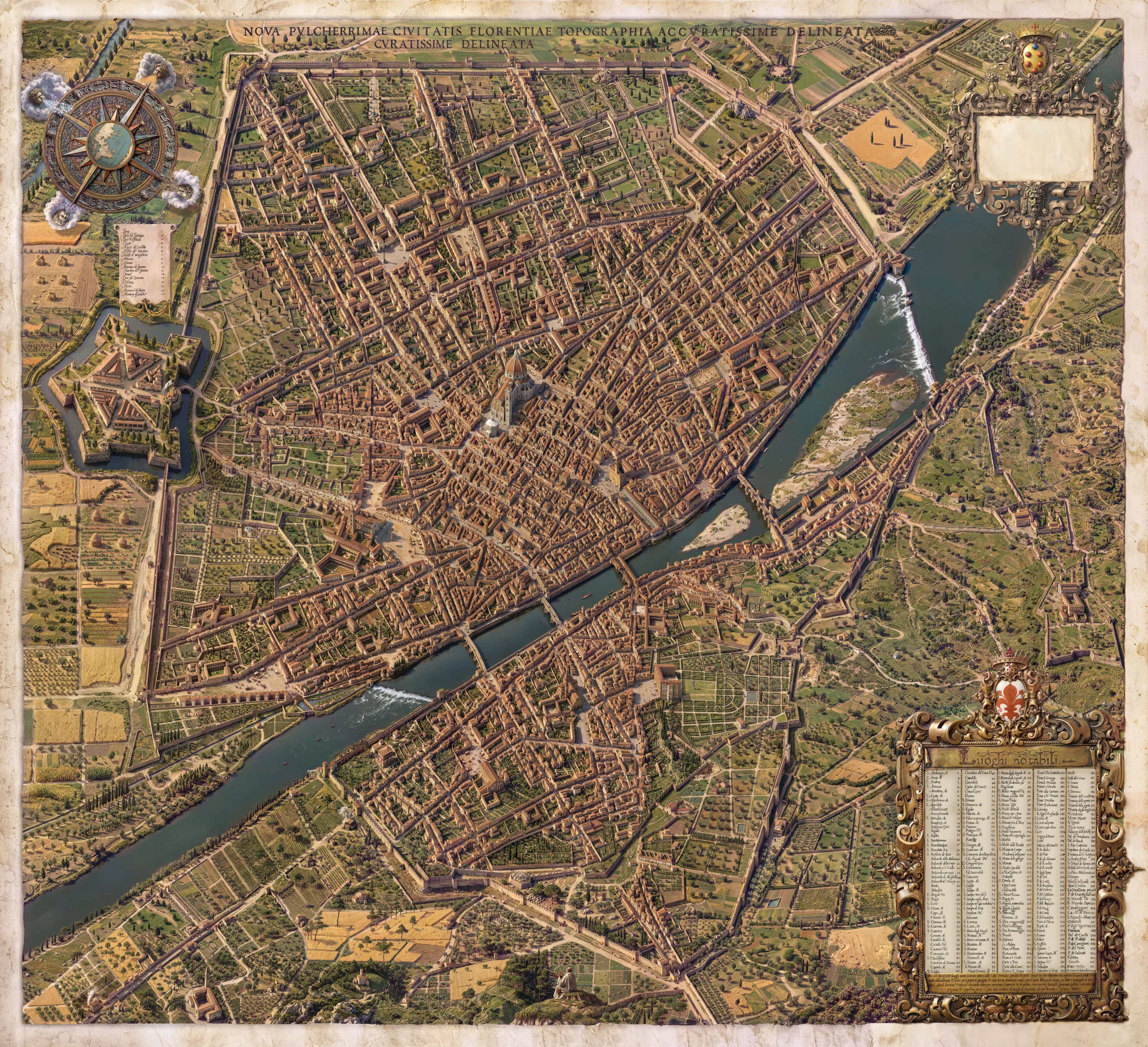
A VIEW OF THE PAST, READY TO EXPLORE
From Stefano Buonsignori’s drawing to a city waiting to be rediscovered.
01 — FLORENCE 1584
Drawn by the Olivetan monk Stefano Buonsignori and etched by Bonaventura Billocardi, this axonometric view of Florence was first published in 1584 and dedicated to Francesco I de’ Medici.
Comprising nine sheets, measuring approximately 125 × 138 cm overall, it was updated in 1594 and reprinted in the seventeenth century by Giovanni Giacomo de’ Rossi. Its elevated viewpoint was probably developed from Monte Oliveto.
Historical sources: Brown University · Hidden Florence · Palazzo Spinelli
02 — THE PROCESS
Preserve the character of the source.
Make its details easier to read.
Open up new ways of seeing.
The digitised historical image is the starting point. Digital restoration brings continuity and clarity back to the view.
THE SOURCEHand colouring, building by building: roofs, fields, trees and shadows reveal the structure of the city.
THE INTERPRETATIONThe photorealistic reinterpretation follows the map’s linework, informed by architectural research and careful revision of the details.
THE RECONSTRUCTIONA researched visual reinterpretation, in which the historical source and reconstruction choices remain distinguishable.
03 — THE STUDIO
AGOSTINO MANCA
FLORENCE, ITALY
My name is Agostino Manca and I create visual reconstructions of historical heritage. My work begins with drawing and the ability to imagine a form before creating it.
My approach starts with what we can still observe: a map drawn in 1584, a ruin from Roman times. This surviving evidence remains the reference point for the entire reconstruction. Study and research allow me to develop plausible interpretations and give form to what can no longer be seen.
New technologies, including generative AI, are the tools I use to turn this process into images: an advanced “paintbrush”, guided by observation, research and careful revision of the details. The aim is to bring a fragment of history into view, making it immersive, understandable and open to exploration.
THE MAP, IN YOUR SPACE
Buonsignori’s Florence becomes a print to discover up close, one detail at a time. Monochrome, colour and photorealistic editions will also be available in large formats.
Prints are in preparation. Message me on Etsy with your preferred edition and the size you have in mind. I’ll update you on formats and prices, with no commitment.
Ask about prints on Etsy ↗05 — CONTACT